
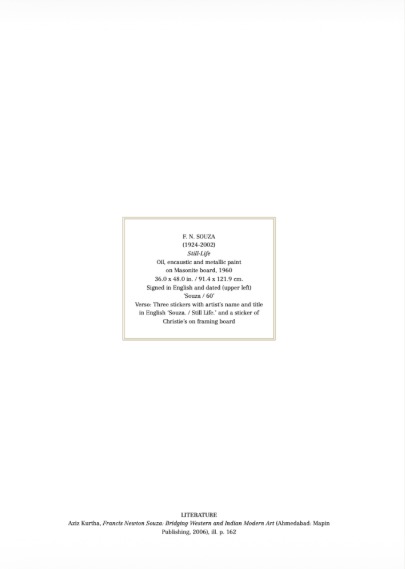
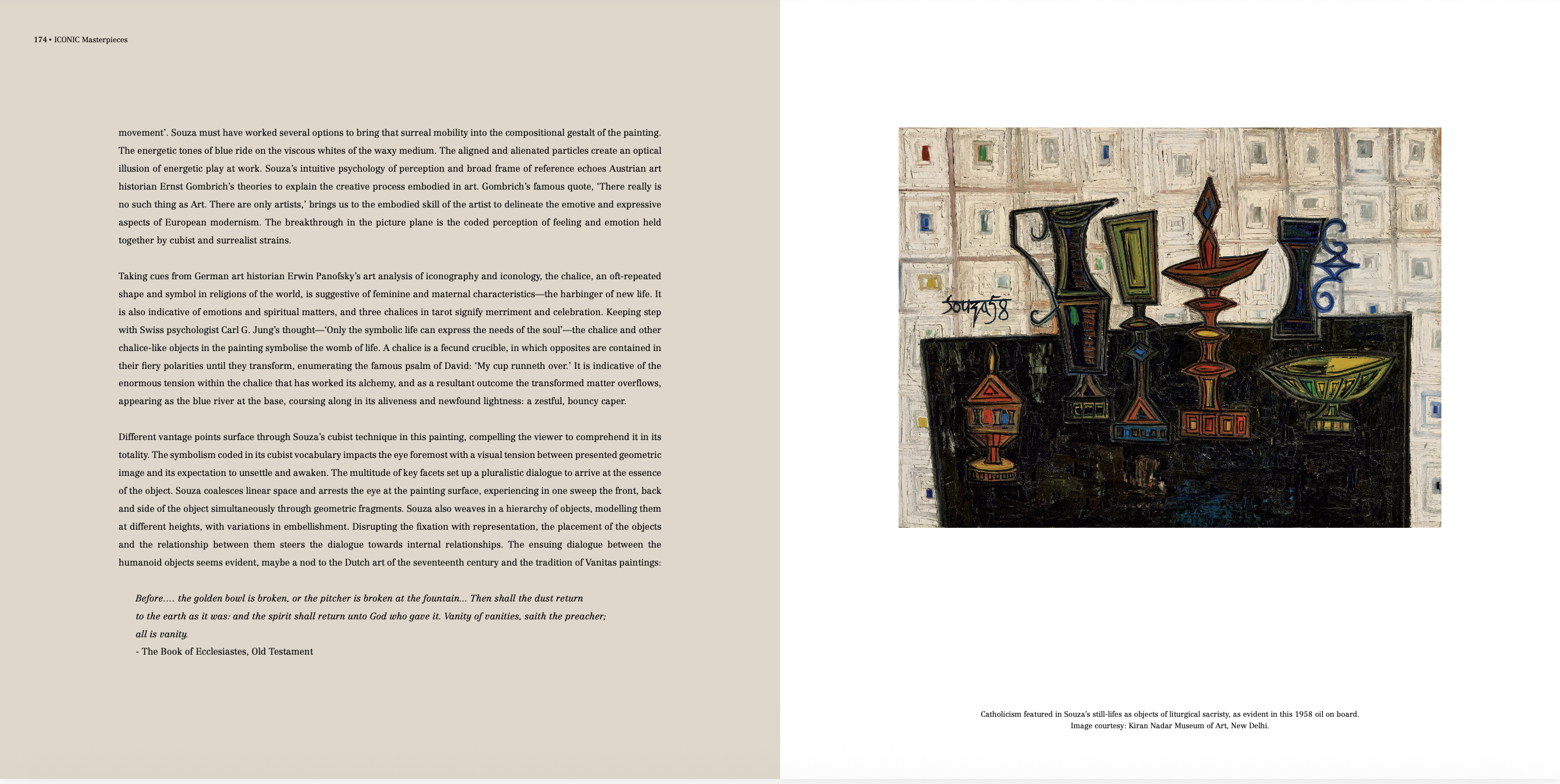
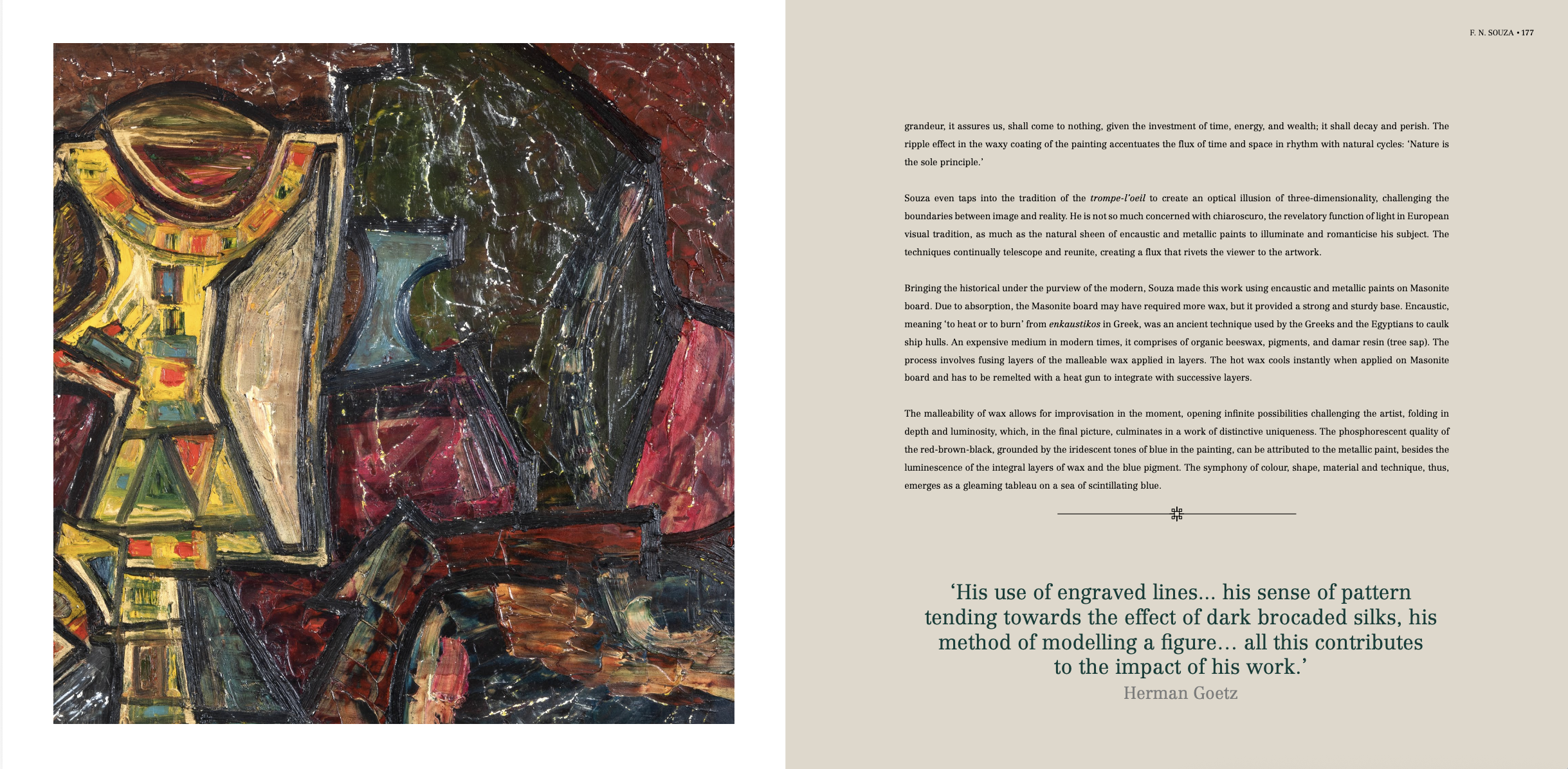
FN Souza's Still Life 1960, ICONIC - 04 Delhi Art Gallery, Art Mumbai
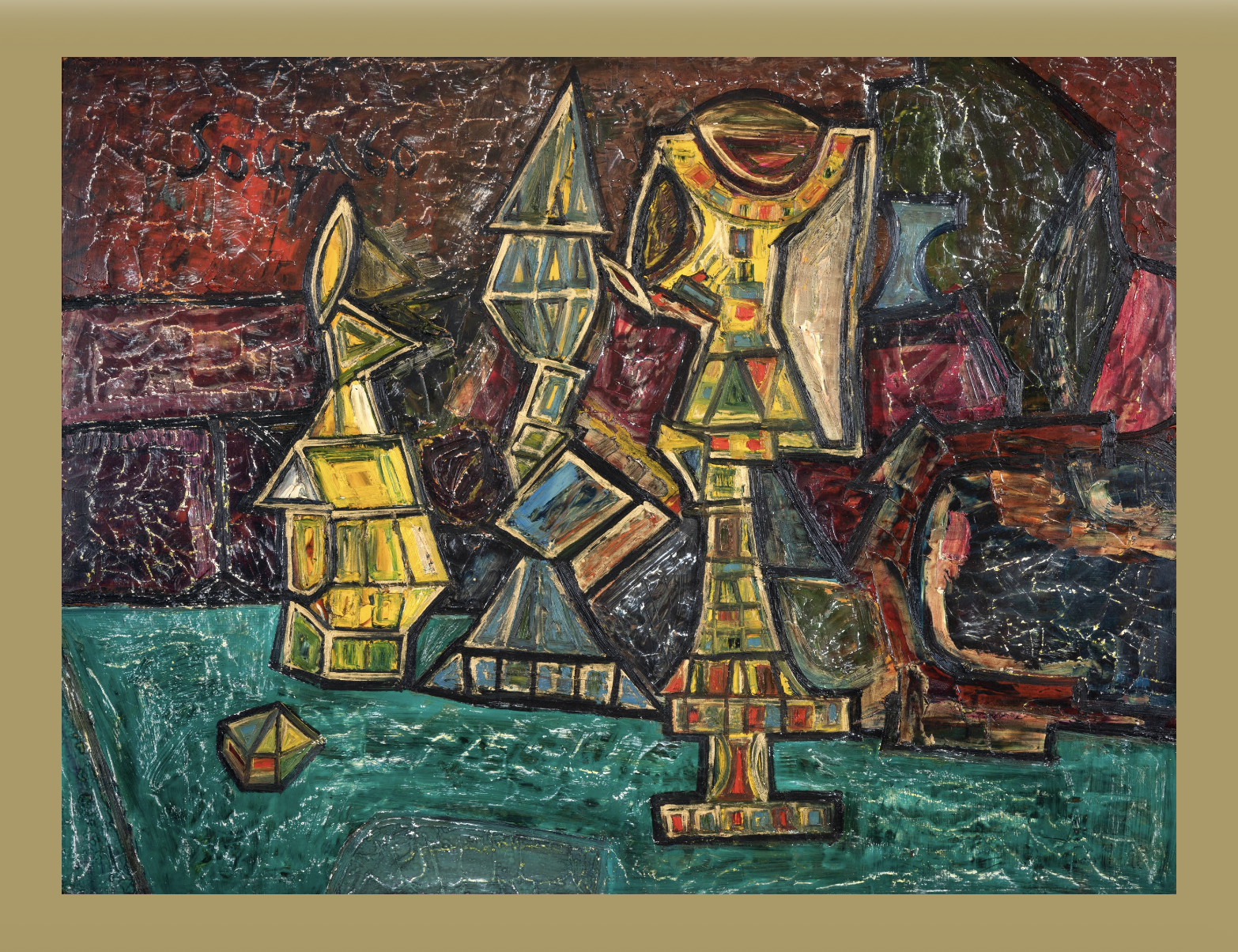
The Darkness and the Star : Love, Longing and Letting Go
Kalanam pratamam chitram; dharmartha kama mokshadam. Mangalya pradam chaitad; grihe yatra pratishthitam”
Painting is the best of all arts, conducive to right action, pleasure, wealth, and spiritual freedom. It is highly auspicious and gives the greatest pleasure when placed in a house
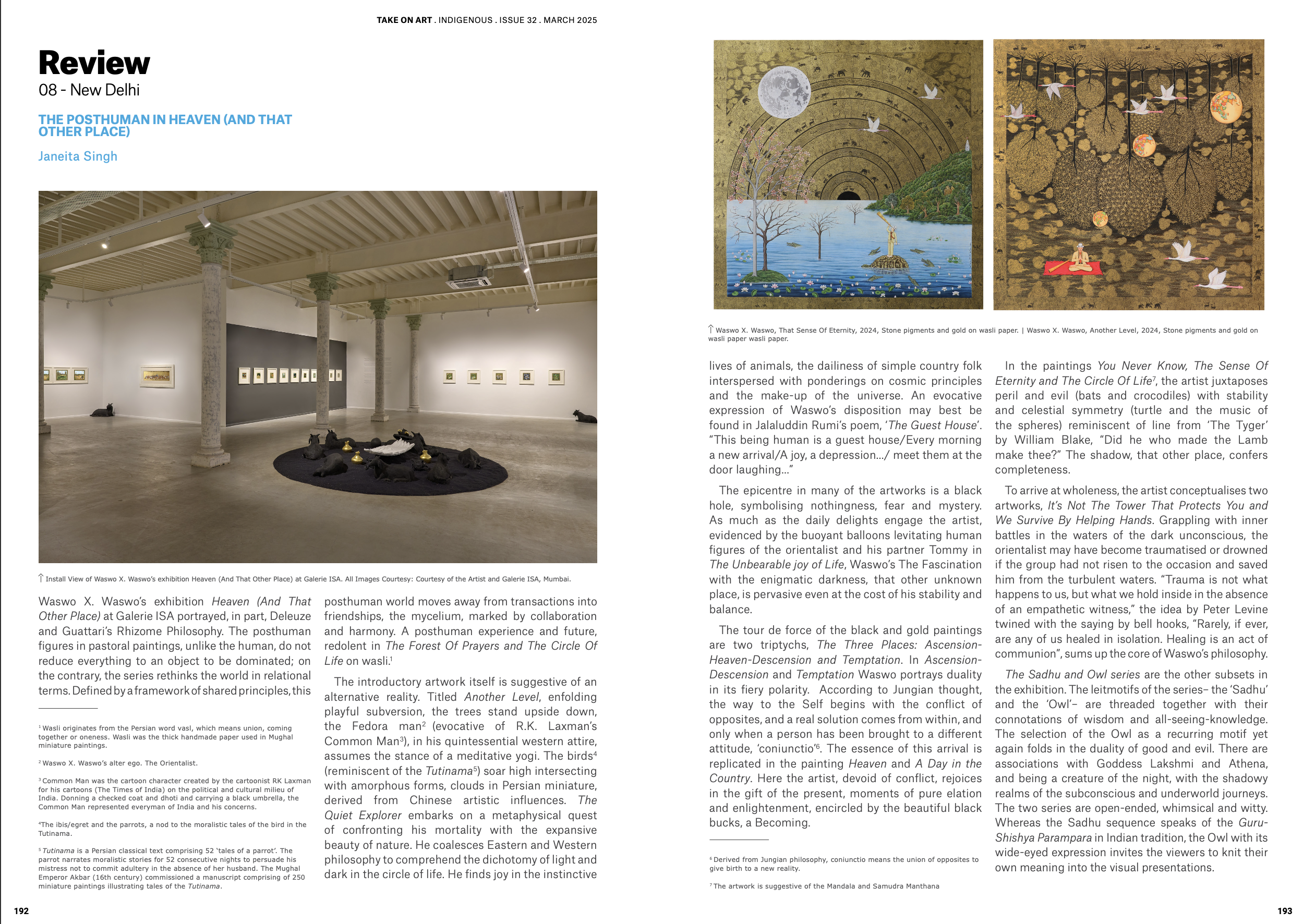
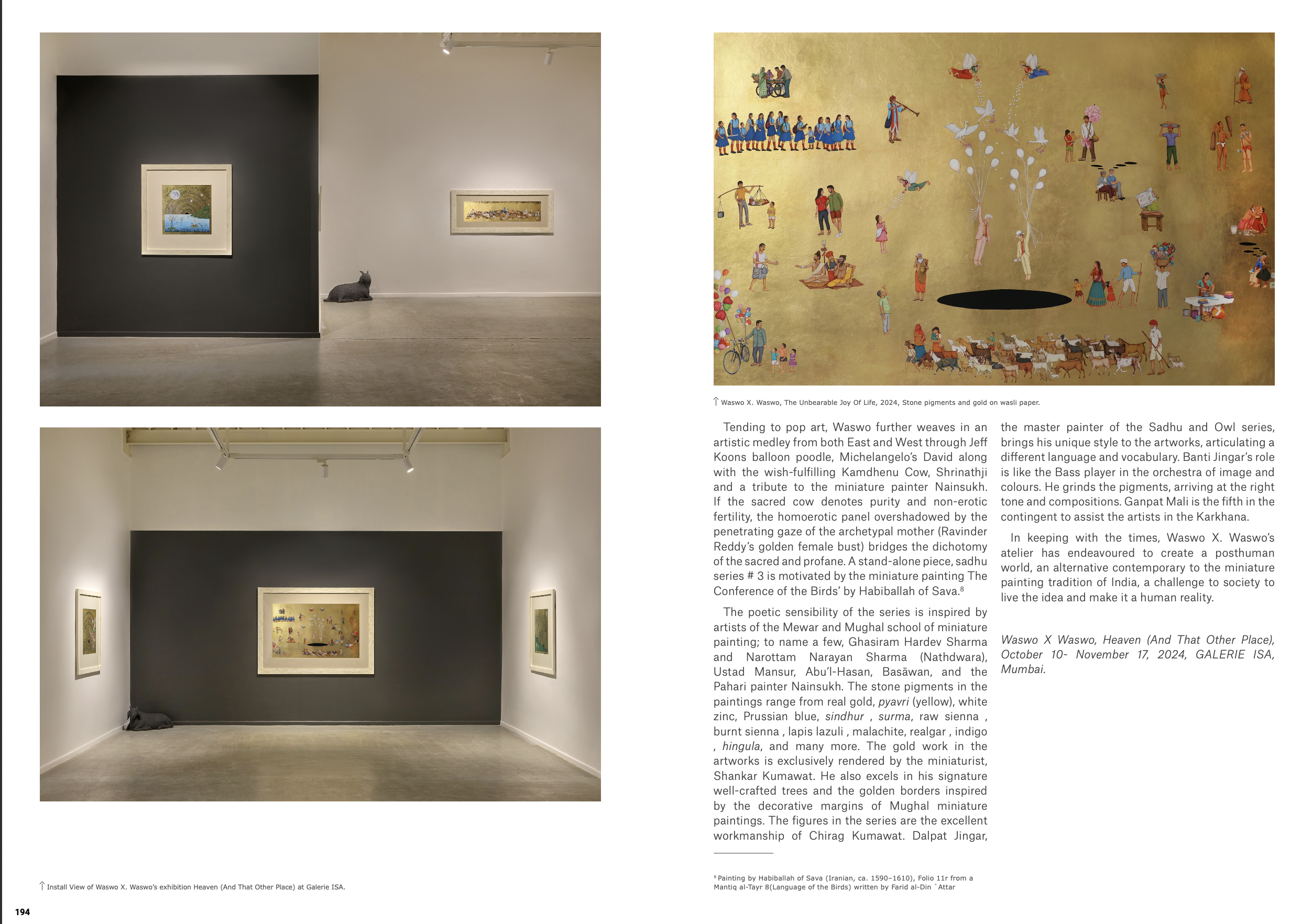
Anachronism abounds in the works of Waswo X Waswo and his karkhana committed to the miniature painting tradition of India. Sir Walter Scott hailed the use of anachronism, ” It is necessary, for exciting interest of any kind, that the subject assumed should be, as it were, translated into the manners as well as the language of the age we live in”
However, the progress in Waswo’s art practice does not necessarily entail linear evolvement, but rather a Jungian spiral. A cyclical movement in loops that marks new points, “upholding the idea of constant growth, of something that keeps unfolding and regenerating in ever-expanding circles” In Waswo’s works, the miniature painting tradition of pastorals becomes a site of mythic reality, not rooted in nostalgia, but reaching towards alternative futures. In the exhibition, Darkness and the Star, a tribute to his partner, Tommy (Kaka) Livieri, Waswo celebrates a real-life love story entailing the joy of union, loyalty, perseverance, and ultimately separation by death, and letting go through the boldness and freedom of the composition, as well as astute exploitation of the rich palette.
In the series of artworks under consideration, Waswo X Waswo and Tommy (Kaka) Liveiri in idyllic settings, sport perennially as the archetypal lovers mapped on the much revered icon, Radha and Krishna, or the legendary pair, Nala and Damyanti, and the ubiquitous theme in the Savant Singh- Bani Thani Krishnagarh paintings. The nuanced embedded narrative morphs the trajectory of archetypal lovers to alternative pairings, a quest for new couplings and identity, radical and subversive even for the times.
And yet, the paintings evoke a sense of timelessness, “a play played eternally before all creatures” in a world of myth and poetry. As Ananda Coomaraawamy expounds, “In India, the conditions of human love, from the first meeting of eyes to ultimate self-oblivion, have seemed spiritually significant, and there has always been a free and direct use of sexual imagery in religious symbolism….. one and the same time sensuality has spiritual significance, and spirituality physical substance…..and painting that depicts a transfigured world……a world of imagination and reality, seen with the eyes of Majnun”
Susan Sontag further extends the concept, “….the difference between a story and a painting or photograph is that in a story you can write, he’s still alive. But in a painting or a photo you can’t show , ‘still’. You can just show him being alive”
Simple and monumental in design, the artworks capture the mood, flavour and charm of Rajput paintings, redolent with tendernness, gravitas and reverence. Poetic and evocative, the atworks convey rejoicement in love bordering on purity and spirituality, resonating with the essence of human love delineated in the cycle of Marc Chagall’s paintings, Song of Songs The connect to the universal and infinite is explored through earthly love; to experience the divine through a deep connect with flesh and blood material bodies, nature and animals. Brilliant but stylized landscapes overiding on compassion and a polyphonic melody, of human -divine -animal figures breathing in synchronization, but retaining their purity and uncompromising luminosity. One is filled with exhilarating joy in the mosaic of colour, basking in the play in the lap of nature to a degree also remindful of Jean-Honoré Fragonard paintings of the Rococo period. Slowly the facility and exuberance of bucolic charm gently awakens the erotic; the mushroom popping its globular head from the fecund earth and babbling streams, whose sinuous course and swirling whirling waters become a symbol of the passion of the lovers. The fulness of the ripened mangoes, the gurgling rivers, the mating deer, the twined tree trunks, the languidness of human bodies beneath the tree canopy, the inviting pool and the artwork , Parable of the Storm, is indicative that it’s peak summer followed by the monsoon, a season most condusive for lovers in the Indian classical tradition.
The archetypal lovers in the artwork, refreshingly also bring alive the lyrical poetry of the 16th century Punjabi Sufi Saint Shah Hussein and his love for the Hindu Brahmin, Madho Lal; a meetings of the hearts, an inseparable bond beyond death, also revisited in the contemporary writings by Sarbpreet Singh. Madho Lal became Shah Hussein’s disciple and spiritual successor and their union (their names are fused, Madho Lal Hussein) regarded as a metaphor for love and harmony and a challenge to the social and religious institutions of the times. The lovers soulful connection rooted in purity and spirituality is celebrated till date at the Sufi Shrine in Lahore where they are buried together.
In tandem, the sheer beauty presented in Waswo’s artworks is not just pictorial but undergirded by deep emotion. A relationship of the heart, nerves, and cells of one’s being, called to testify to the truth of being and becoming. In the Indian philosophical tradition, rooted in the oneness of the whole of creation, the quest for eternal truth beyond the maya, or illusion, drives all human activity. Polyamory is erroneously regarded as a new age topical trend. The miniature painting tradition mapped on Indian philosophy of symbiosis, the Tao, has imagined and idealized plants, animals, humans and inanimate matter, their sing-song harmony and love with great tenderness and emotion.
In Waswo’s present series plants and animals populating the artworks , the langur, the black buck, squirrels, crocodile, the buffalos and butterflies are carved with great profundity and sensitivity, akin to current international exhibitions. A case in example, the artworks of Kim Greem , the artist from Korea and Jeffery Gibson’s bronze sculptures marking the façade of The Met museum in New York. Titled, ‘The Animal That therefore I am, 2025, the animal sculptures “underscore the importance of the interconnected relationships among all living beings proposing how we might live differently as we navigate between the human and environmental realms’’.
The archetypal lovers suffused by the harmonious medley, seem to touch upon the experience of ecstacy, the universe in verse, akin to Brahmananda (the ultimate spiritual bliss), in paintings such as Heaven on Earth, Closer to Heaven, Another Day in Paradise, and At the Tree of Harmony. These artworks seem to mirror ananda (bliss), the experience of perfect beauty and harmony that lifts the veil of illusion, and in those fleeting ephemeral moments they perceive grace holding the brahmand (universe) together. Art becomes an ally to record those peaks of aesthetic joy and sublime harmony. Reminiscent of Chaiyya-Chaiyya, an onomatopoeic title of a hindi song, that is a poetic expression of love twined with spirituality. Of finding paradise through the purity of love, symbolized by the the words, chaiyya-chaiyya – walking in the shade of love and arriving upon paradise, the love of the divine.
“Jinke sar ho ishq ki chhaon, paaon ke neeche jannat hogi.”
“Sar ishk ki chhaon chal chhaiya-chhaiya. Paaon jannat chale chal chhainya.”
Those who have the shade of love over their head, will have heaven at their feet.”
“Walk in the shade of love, and you’ll feel like you’re in heaven.
Nonetheless paradise and darkness are two sides of the same coin, as the wisdom of the artist declares in the title of the exhibition, a duality in clear terms. From the dance of light and bliss the narrative parleys into the unknown, the darkness, the mystery of the universe; from which everything arises and after having played its role, returns. This ubiquitous nothingness shadows the play of light, joy and togetherness in the world of these painings. Every union is tinged with the colours of separation and dissolution, that lends it sweetness and beauty. The ephemeral nature and impermanence imparts an ethereal quality to love and joy, evocative of the ‘Ode to a Grecian Urn’ that makes mortality all the more present and undeniable. The poignancy of Keat’s quote hits home, “Beauty is truth, truth beauty,—that is all/ Ye know on earth, and all ye need to know”
The paintings, The Darkness and the Star (Suite), Seeing the Big Picture, The Comprehensions and To Suspend Belief are contemplations to comprehend the conundrum of life. Waswo steeped in Western thought and philosophy, juxtaposes the East-West perspective, the scientific approach and spirituality, to arrive at a balanced interpretation. The Eastern point of view of faith, oneness of the universe and seeing the big picture grounds him, leading him away from dissection, the study of separate parts, to find the truth. The fallen statue of David in Another Day in Paradise#2, The World Turned Upside Down, and the scrutiny of the broken part of the Brahmand (Cosmic egg) in Seeing the Big Picture, these are replaced by wholesomeness, life giving artworks, such as, The Inevitable Direction, the Ascension and the Prayer, Letting Go and Together Apart. In the Inevitable Direction, Waswo takes a cue from Rene Magritte’s The Blank Signature, to render a surealist reality overlapping with occlusion illusion, but adapting it to the Indian concept of a pari.
The allegory in The Passage points the suite of paintings in the direction of symbolism and metaphor. The buffalo is variously regarded in different religions and communities. In Indian mythology, as Yama’s vahana it is primarily a symbol of the afterlife, carrying souls to the darkness beyond, the eternity. The buffalo embodies powerful, steadfast qualities, reflecting the unyielding nature of death, the formidable force that balances life on earth, through the ultimate truth about Karma and righteousness.
The motif of the lotus flower in Letting Go and All Life’s Colours have Faded is relevant to Indian philosophy of growing into beauty and peace through detachment. Towards Eternity suite faces the pari’s, the benevolent femnine, that harbours the qualities of deep wisdom, insight and receptivity, the bridge between conscious and unconscious realms of the cosmos.
“ A painting cleanses and curbs anxiety, auguments future good, causes unequalled and pure delight, kills the evil spirit of bad dreams and pleases the household deity. (translated by D Stella Kramrisch). ,
Vishnodharmottara Ch. 43. V . 38
Prescriptions for the preparation of vegetable and mineral colours are given in the Chitrasutra Seeing the artists at work in Waswo’s Karkhana at Udaipur, one would naturally arrive at the conclusion that these master artists have intricate knowledge of the ancient treatise on paintings and colours, passed hands on, through generations of family lines and regional – religious interconnections. The stone grinding of colours, mixing with water or natural tree gum, filtering, skimming, is but a long meditative process, undertaken with love and patience over days. While Shankar Kumavat’s gold work in the series is incomparable, Chirag Kumavat’s figurative drawings of humans and animals bring vibrancy and aliveness to the works. The golden shower of the Amaltas and Gulmohr in the height of summer, in the artwork, A Day at Work, has been wrought with great finnesse. While he is meticulous with the attire of the local Dangi community, the pagri, white dhoti, black nazar ka dhaga, the red gamcha; the women in ghara choli, silver anklets, golden tika, lac bangles draw attention. The Bishnoi community hold the black buck, Krishna’s mrigam ( Krishna’s deer), with great fondness and felicity. In the artwork, Heaven on Earth, an exquisite terracota-sienna monochrome, contrasted with nearly a 100 black bucks invites contemplation on the lovingly carved dancing, prancing, making love, gossiping, strutting beings. The fine line drawing and brush strokes illuminate the gentle arch of its back, the softness of the eyes, the strength of the haunches, rendering it reviting. Bunti Jingar under the stewardship of Dalpat Jingar, seems to have marked a high point on the learning curve of his accomplishments as an artist, with remarkable landscape work in Closer to Heaven and A Perfect Place-A Perfect Moment,Letting Go, Another Day in Paradise#3. The numerous trees, idealized impressions of Neem, Mango, Banyan, Khakra (leaves used to cook the baati in open fire), sandhya ka phool, not only echo the ardour of the lovers, but the kainath in its glory. . The 3D sculptures and the animation reteirate and complment the paintings, taking the dialogue forward.
The tour de force, is an artwork by Dalpat Jingar. The transition from A Day at Work and Night at Play to All Life’s Colours have Faded Away is phenomenal not only in appearance and sentiment but the treatment of line, shape, form and colour. The implied lines in the compostion signify the dark night of the soul. With gnarled tree trunks, wounded bark, slit open worn out tree stumps, snaking tendrils and vines, stringy tertiary roots vocalize the emptiness, grief and loss of Waswo, deprived of his soulmate. Nature stripped of colour is symptomatic of the steadfast companionship that nature shares with human beings. The artist metaphorically showcases the rarefied sensitivity and consciousness of the human parted from his soulmate, a blooming scene transformed into desolate landscape. The twain are inextricably woven.
Waswo’s atelier has endeavoured to illuminate the profound philosophy of human existence, drawing the viewer’s attention to universal truths of life and death and the art of dying. At the same time there are strong topical themes undergirding Waswo’s works. Through Waswo’s art practice, the enduring legacy of miniature painting tradition of India remains true to growth and evolvement, as it encounters the same intersections on the spiral, but from a different vantage point of awareness and understanding.
That brings us full circle to Waswo’s practicing quote by Marcel Proust,
“The real voyage of discovery consists not in seeking new landscapes, but in having new eyes”
The Intruder: An Art Intervention
Waswo X. Waswo’s box set of digital prints is an intervention on George Franklin Atkinson’s 1 vintage prints in the book, Curry & Rice. 2 The fiery colonist-colonised polarity in each frame lends the digital prints a magnetic quality. The white colonials’ condescending, commanding
and uppity demeanour, juxtaposed with the desperation, deprivation and resigned destiny of the ruled weaves in high drama. But who is the figure in the fedora hat with a red tie amidst the servile, slavish and subservient subjects? The fedora man 3 in each print is Waswo X. Waswo’s therapeutic art intervention on Atkinson’s sepia-tinted lithographic prints. Waswo steps into the shoes of the eminent artists Robert Rauschenberg 4 and Ai Weiwie, 5 who, in line with the construction-destruction- creation principle, arrived at a new artistic statement aligning with their times. However,
Yuan Cai and Jian Jun Xi 6 and the Chapman brothers proclaimed that their interventions were a rectification. The Chapman brothers intruded upon Francisco Goya’s ‘Disasters of War,’ a ‘rectification,’ morphing it to a surreal horror fantasy of deathly grins.
Waswo’s series, ‘The Intruder,’ aligns with the work of the Chapman Brothers, but the
artistic intervention comes with a difference. It’s an incisive cut in the veneer of Western
supremacy, transgressive of the picturesque servitude in works of the modernists like the
lens-based artist Norman Parkinson and his photo-shoot in India; exemplified by Barbara
Mullen and the native girl on the cover of British Vogue 1956. Waswo’s postmodernist non-
violent intervention is a retroactive trajectory, decolonising art history.
The lost second book of Aristotle’s Poetics, 8 a manuscript that did not survive antiquity, is
supposed to contain the catharsis of humour. The incomplete surviving Poetics, may be
inferred from the writings of Plato and Cicero. Plato, the first philosopher to comment on
humour in a meaningful way, proposed the superiority theory of humour. When we laugh, it
is at the expense of someone’s adversity, or socially awkward behaviour, and that makes us
feel superior, joie maligne. 9 Laughter corrupts judgement and interferes with intelligence
and soundness of mind. The power dynamic woven in humour cautions use of laughter;
however, Aristotle emphasised the importance of living a cheerful life. And one of the ways
is by wittiness, the golden mean between coarse boorishness and gross buffoonery.
However, Waswo chooses to go with the more favourable philosophy on humour by Cicero.
Humour is a blessing of the Gods that diminishes the harmful intensity of a situation and the
enhancement of incongruities achieves comic effect helpful in exposing the truth.
It seems that Waswo was inspired by Atkinson’s lithographic plates, a definite satire at the
lofty and supercilious pursuits of the Britishers, the ingredients of a social life stationed in
the town of Kabob. 10 Waswo, a committed Jungian at heart, I believe, in postcolonial times,
taps into the psychological distance of violation and creates comedy—a look back in mirth
at the state of affairs as it existed during colonisation. His series revitalises a recovery akin
to Ashis Nandy’s book, The Intimate Enemy, 11 the loss and recovery of the self through
humour and exasperation at the human condition. Through collaboration, sometimes
tongue-in-cheek and at other times disruptive, the fedora man affords amusement and
cheer. A prominent mark of healing and recovery is that we talk about the trauma without
the energy of emotion—a catharsis that sees the absurdity of human affairs, finding balance
and strength in the lived story. In tandem, the cover artwork shows the ‘Orientalist’ in a
nonchalant stance, drinking water from his bottle, and looking at the lady sitting side-saddle
on a horse, followed by the next artwork, that finds him plonked on a buffalo, munching a
kachori 12 in the great bazaar of Kabob. In the words of Dr. Gabor Maté, “We carry imprints,
wounds of the trauma which can be healed in the present, no matter what the past was.”
The prints 4, 7, 10, 11 and 15 introduce the Magistrate, Collector, Padre, Joint Magistrate,
and Colonel of the Regiment stationed at Kabob. The characters are invested in their
positions of authority and pompousness. Resting on their laurels, they lord over the land
and the menials. Attended to by a retinue of diligent and hard-working native grooms to
ensure their comfort and dietary fetishes, they are blind to the chuckles and disdain of the
Orientalist in their midst. At other times, the fedora man walks unfazed, accompanied by his
poodle or sits one with the natives, self-possessed, sipping his tea. The artist also makes
adequate use of visual synecdoche. In artwork 4, merely the red tie and the hat signify the
presence of the Orientalist.
In contrast to the regimented officials, the jolly sporting Griff, 13 Godower, in plate 2 brings
enlivenment to the station with his equine pastimes. He is the proud possessor of a
diminutive ‘Tat,’ 14 given to peculiarities and a restless spirit, and bestowed the name
‘Tantrums,’ by his master. While the faithful valet is meticulous about his Lord’s martial
turnout, the table attendant serves him tea, and a groomsman attends to the recalcitrant
Tantrums, the fedora man perches himself on the pony, with his back to the ministrations,
firmly turned away from the fuss and fawn being enacted behind him.
In artwork 12, the Orientalist is content to lie on the floor, drinking to his heart’s content, a
disruption in the Burrah Khana, the feast with its ceremony and flush etiquette, executed
with flourish and style. Further, quite blasé about the atmosphere around him at the Ball,
where the waltzes, polkas, schottisches and quadrilles move in sync with music, he
propositions a brown sable to dance with him; amid the gentle glistening faces of the fair
maidens, draped in clouds of muslins, tarlatan and crepe—in line with Frank Sinatra’s
song, “I find it all so amusing/ To think I did all that/ And may I say/ Not in a shy way
Oh no, no, not me/ I did it my way.” Not for him the allure of the swirl of gowns and
garments in the ballroom under the glowing chandeliers. In a simple flourish, the artwork
makes a frank statement on homosexuality within the matrix of a conflicted social milieu
and its take on other kinds of sexualities.
Atkinson’s ‘comical ploughman’ gets Waswo’s ire, and his rueful visual expression takes the
form of white balloons, drifting in on the scene, perhaps from a boisterous Anglo-Indian
party nearby. The intended intrusion of fickleness and festivity in white on the portrayal of
an industrious farmer winding his way home with the lengthening shadows, a slow, shuffling
gait, wearied and bent under the weight of the plough on his head, is a high-octane punch.
The cookhouse is a tableau of smoke and grime, with an assemblage of a few pots,
saucepans, a ladle, knife, and the silver-haired cook and his sous chefs sitting on their hams.
From the earth’s lap, with great dexterity and energy, they will have the most mouth-
watering spread ready in no time, that rivals lavish feasts from the West. The fedora man
planted on a table, at ease in the native kitchen and with its inmates, sits chomping on KFC
chicken wings. A curious observer, he watches with intrigue the amazing prowess of the
native brethren, the master chefs. Awed by their nurturing feminine sides and fine
aesthetics in the service of feeding a station, salivating – wholesome food.
In contrast, artworks 8, 9 and 18 call upon the masculine powers of the alpha males, in step
with the elephants and hounds, targeting boars and tigers in the wilderness surrounding
Kabob. The thrill of shooting game, the bigger and more ferocious, the better. The shrill war
cry, the adrenaline rush of sticking a spear into a deranged angry wild pig or tiger lends the
men incomparable stature and a sense of hubris. In contrast, Waswo’s intrusion on the
mayhem is about saving the tiger. Taking courage in both hands, shaking uncontrollably, he
stands between the hunting party and the bloodthirsty tiger. The non-violent intervention in
the face of violence comes with injury, and he is being rushed to the hospital in artwork 19.
In artwork 16, the artist, a westerner amid the natives is pulled by the polarities, East and
West. For all his empathy and human connect with his fellow brown-skinned humans, he
questions his truth and ambiguous stature. In that moment of ambivalence, he
conceptualises himself as the white man wearing his red tie and hat, in charge of the
traveller’s bungalow. Held by an internal conflict, he is both attracted to and repelled by the
white man. The two white men mirror each other, reflected in their light and shadow—
mutable, and carriers of imperial power and authority. Riding on simple brush strokes,
Waswo conceptualises his interiority, the twining of the personal and the political, a
silhouette of power and groundedness, apathy and empathy. A question hangs in the void,
‘How far have I come?’—merging with these lines from Derek Walcott’s poem – “The time
will come when, with elation, you will greet yourself arriving at your own door, in your own
mirror […] peel your own image from the mirror. Sit. Feast on your life.” 15
The seat of high social drama, the fictionalised town of Kabob appears in artwork 20. Its mud-
built-edifices, the botanical garden, the civil lines, the bandstand, bungalows, assembly
room, theatre, the church, hospital, barracks, the elegance and high fashion on the mall.
Waswo accentuates the semi-fiction through a surreal twist, by appending the fraying
remnants of the memory of his brother to the fictional town of Kabob; by adding the
astronomical balloon and the telescope. The fedora man stands elevated on a boat, peering
at the town and the future through a telescope; an objective view. It enhances the
dreamscape, amplifying the Shakespearean contemplation, “All the world’s a stage, And all
the men and women merely players; They have their exits and their entrances; And one
man in his time plays many parts…’ 16
The Intruder series, a collaboration between Waswo X. Waswo and the miniature artist
Rakesh Vijayvargiya first appeared as an exhibition at Gallery Espace in 2020.
1 George Franklin Atkinson was a scholar, artist and officer stationed with the Bengal Engineers
during the Sepoy Mutiny of 1857. The son of James Atkinson, the famous surgeon and artist, he
painted scenes of colonial life and battles in India.
2 George Franklin Atkinson, Curry & Rice on Forty Plates Or The Ingredients of Social Life at ‘Our
Station’ in India. Atkinson’s book is a satire of the Britishness of the colonials, who had begun staking
their superiority and imperial claim on their subaltern subjects after the 1857 Rebellion and the
dissolution of the East India Company.
3 The Orientalist, the artist’s alter-ego.
4 Raushenberg erased a 1953 Willem De Kooning drawing (with the artist’s permission).
5 Ai Weiwie’s intervention, Dropping a Han Dynasty Urn (1995), involved dropping a 2000-year-old
antique urn, and the documentation of this performance coded a message. By smashing it, he
challenged tradition, to bring in a new set of values suitable to his times.
6 The artists jumped into Tracey Emin’s My Bed because they thought it was not ‘unmade enough’
(Two Naked Men Jump into Tracey's Bed).
7 Jake and Dinos Chapman were members of the Young British Artists (YBA) group. In Grande
hazaña! Con muertos!, their intervention on Goya’s pieces, they superimposed demonic heads of
menacing clowns, grotesque animals and ghastly masses of decomposition, showcasing the barbarity
of Napoleonic wars. Mad men fighting mad men, the Freudian id let loose in war zones, upsurping
reason and rationality, the outturn, abattoirs of mutilated, butchered bodies, the evil and mayhem.
They termed their intervention ‘rectification,’ an adaptation for contemporary impact. It was a
powerful satire on the Allied Forces professing to bringing democracy to Iraq, just as Napoleon had
claimed to introduce Enlightenment ideals to early-nineteeth-century Spain.
8 Aristotle, Poetics. A philosophical treatise on different forms of poetry, and its effect on the
audience, especially concepts such as mimesis, plot and the importance of catharsis.
9 The term means to derive satisfaction and malicious joy from the misery of others.
10 A fictional town in the Bengal Presidency in Atkinson’s book, Curry & Rice.
11 Ashis Nandy, The Intimate Enemy: Loss and Recovery of Self under Colonialism. The book is a
critical study of how colonialism fractured the psyche of the colonialist and the colonised, and the
search for sovereignity.
12 Deep fried Indian snack
13 Strong lord, a prince
14 Of poor quality
15 Derek Walcott, Love after Love
16 The well-known monologue from William Shakespeare’s play As You Like It, compares the world to
a stage and life to a play.
Art India, Volume 22 Issue 4, December 2018 Playing Favourites, Picture of Self - Possession p. 44-45
Souza and the Nude
I walked into the exhibition gallery one day because I saw the nude through the window glass of the exhibition gallery. That was weird, I thought, seeing myself in the woman striking a nonchalant pose on the canvas. One might have expected the guilt-ridden, bashful ‘Venus Pudica types’, with a perpetual blush marking her countenance or a prevalent supine, spread-
eagled, spineless she-form. They told me the famous (and in other ways infamous) artist, FN
Souza was dead.
Surprisingly, the nude did not seem shy, shamefaced or self-conscious. An air of confidence infused the body language of the nude. She seemed to portray women more naturally than any other female portraits I had seen through Western art history. Peering closely at the watercolour, I read that FN Souza had painted her early in his career, in 1941. Suddenly I
was startled to hear the nude speak against a backdrop of a babble which had invaded the gallery space. I was at the receiving end of what sounded like a chant that had begun long ago, probably in the middle of the last century – a unanimous craving for someone to hear her
sing. I stood rooted to the spot, primevally bewitched.
I was at the receiving end of what sounded like a chant that had begun long ago, probably in the middle of the last century – a unanimous craving for someone to hear her
sing. I stood rooted to the spot, primevally bewitched. The canvas was like the ‘marriage bed’ in Donne’s poem, ‘The Flea’. The nude disclosed that
their bloods – that of the artist and her own, had mingled with ‘no sin, nor shame nor loss of maidenhead.’ The most powerful emotion rather was that of the terror of mutual sexualities –
obsessive drives that are generally over-heaped with myths, the mind being a palimpsest of socio-cultural history. Gazing at the nude, I became ‘a woman looking at Souza look at women’. Seeing the nude
with fresh eyes, I met Dora Marsden’s ‘Freewoman’, a woman who had walked a long way ahead from being a ‘bondswoman’ – that ordinary woman shackled by convention – a pawn in patriarchal history (as wife, mother, sister, spinster, prostitute) – giving birth to individual
end in herself. Insofar as Western art history, from Praxiteles to the turn of the modern era, the procreative sexual woman has been ensconced in her sin and she had been depicted – meek, mute and
modest. Any empowering ‘Freewomen’ stories were taboo. For human beings raised on the tagline ‘beware the body and sex is sin’,- this kind of vision is intensely and profoundly original and the idea of reading Souza’s figurative art becomes absolutely exciting and challenging. Souza plumbed the depth of women’s psyche and then splayed her in rigorous
colours, resulting in his famous female nudes. But contrary to historical artistic practice, in her portrayal there was a difference. He spoke in a definitive feminist idiom. Souza’s female nudes code a sexual revolution, a pictorial language that Souza had elaborately portrayed since the 1940s.
That Souza’s art contains the greatest social possibility is yet to be understood. If society is to become free, the answer lies with liberated men and women, the ultimate egoists. Contrary to her jaded erotic image, in Souza’s female drawings, the nude is constructed and managed
internally, no longer exposed and vulnerable, but assertive and powerful, emphatically nude
Essays in anthologies – The Brave New World of Goan Writing & Art

Camoes in Goa: The Journey of an Epic BY Jugneeta Sudan Runner-up jrlj best in non-fiction 2018
Despite his far-reaching influences on European, American and South African writers, the great Renaissance poet Luís Vaz de Camões (1524–1580) remains one of the best-kept secrets outside of Portugal and its colonies. The title of his epic poem Os Lusíadas,literally means the descendants….. Read More
Souza’s Art Lineage: From Attic to Public Art
Solomon Souza’s art can be traced to a worthy family lineage. His mother, the British artist Keren Souza-Kohn is a painter in her own right and his grandfather, the Goan-born international artist, F N Souza, was a seminal modernist icon who blazed a trail on the 1950s British art scene alongside contemporaries like Francis Bacon….. Read More
Vitesh Naik: I See Myself in Crowds
National award (Karnataka L.K.A) winning artist Vitesh Naik, who began from humble beginnings in Jan 1974, has been awarded the 2021-22 Pollock–Krasner Foundation grant. Considering his passion and perseverance, the outcome has been most satisfying. It began with a sketch of his teacher in history class….. Read More
The Grand (Son) Souza
I knew I was a quarter Indian because I was well aware of my grandfather, the great Indian modernist, FN Souza. —Solomon Souza
Perched high up on a crane, I saw a strapping young man energetically spray-painting Brahmanand, the great goalie and long-time captain of the Indian football team, very near to the footballer’s home in Taleigao….Read More
Art Interview: Laxman Pai and the vibrating line
Laxman Pandharinath Pai was born in Margao, Goa, in 1926. After studying and teaching at the JJ School of Arts, he travelled to Paris where he studied fresco and etching. He is the recipient of several awards including the Padma Bhushan awarded by the Government of India…. Read More
PERSPECTIVES ON KASHMIR: HOMEFULNESS
I have been witness to art vocabulary on Kashmir over the last couple of years in Goa, like studying an Akbar Padamsee diptych of two states in univocal embrace.The slow pace of life, natural environment, plurality and ease of everyday living lures artists to…..Read More.

‘Souza Painted Hell’: A Review of his Legacy
Souza painted ‘Hell’.
Sartre said, ‘Hell is other people’, but Souza’s art laid bare the hell inside human beings that makes individual lives hell, which in turn is then visited on other people No doubt the world today is mired in war, terrorism and hate….. Read more
This is just to say (NT) – Review of William Carlos William poems, a revisit after Jim Jarmusch’s 2016 film ‘Paterson’ after WCW
This is just to say’ is William Carlos William’s most famous poem. Who can convert everyday matter such as a slip or conscious trickery in quotidian domestic life into poetry! That’s WCW for us – a man who otherwise led a contrived life… Read More
Essays in Journals
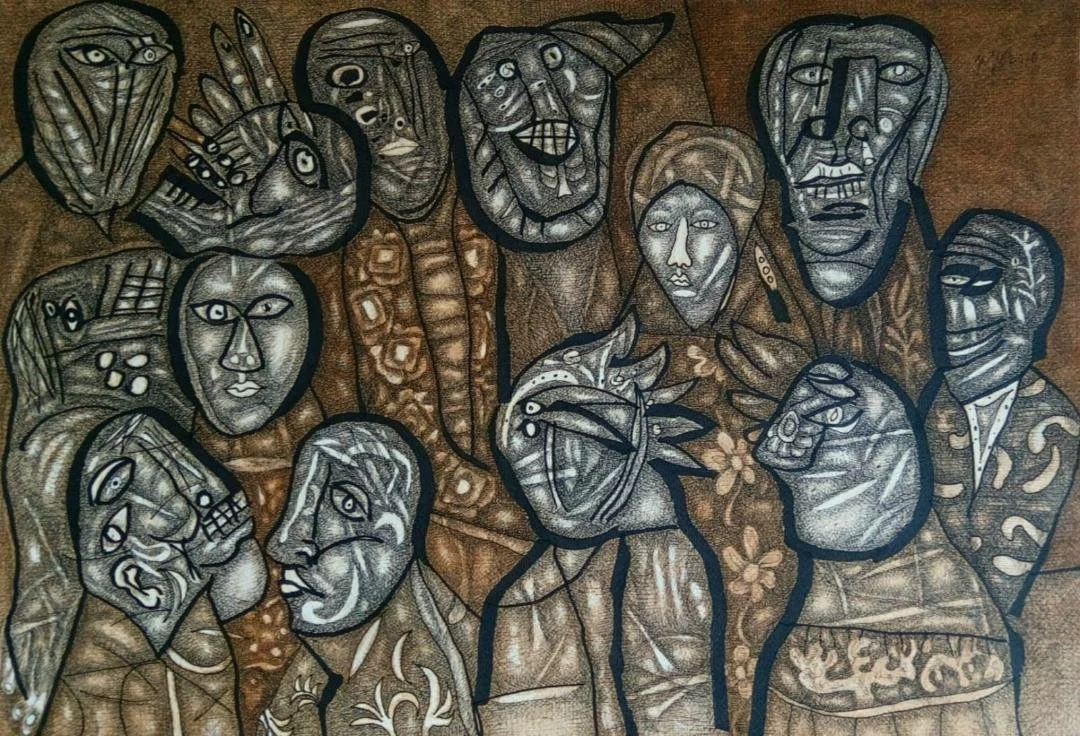
Artist Julio D’Souza: The One Last Supper
The magnetic pull is the metaphor in the painting, a family/community coming together to partake of a meal at the dining table. A masterpiece embedding the dance of ‘Light & Shadow’, the polarities are palpable. Read More….
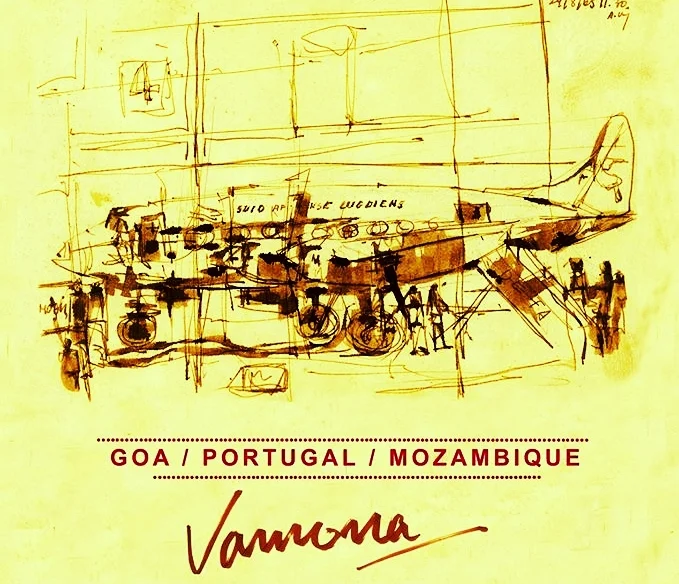
The Knight in the Many Lives of Vamona Navelcar
Quixotically Vamona read chivalrous texts passionately and then implemented the ethos into his existence. Regrettably, reality had moved away and become inequitable, random and prejudiced.. Read More
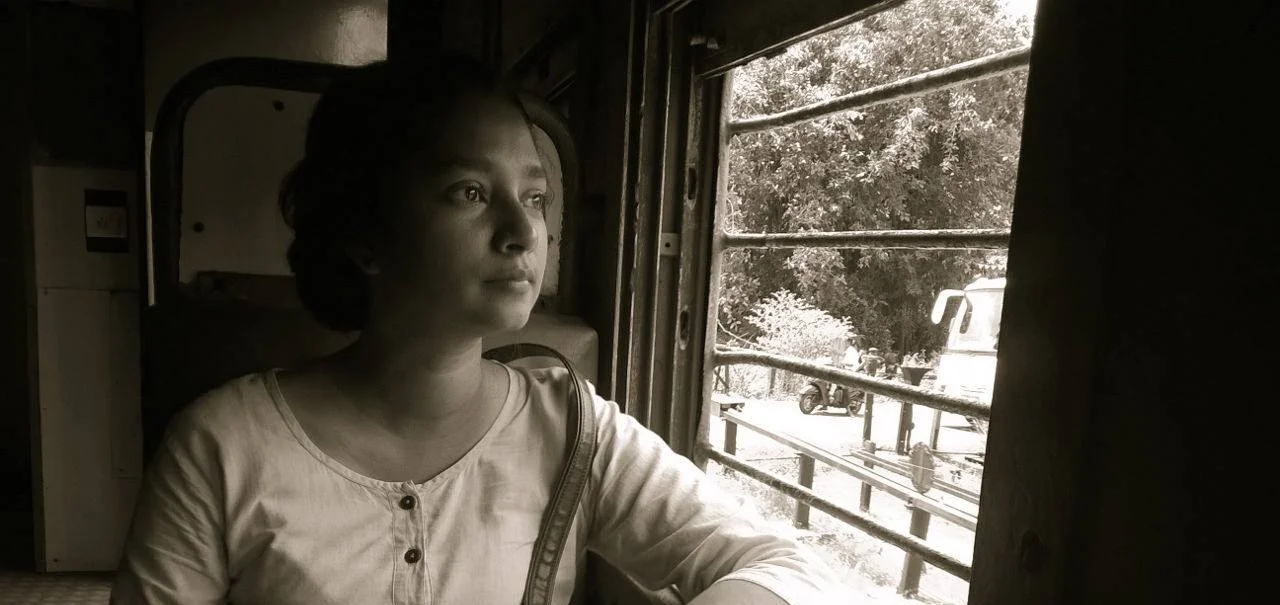
Understanding Loretti Pinto: An Artist at Work
Loretti J. Pinto is an emerging artist from Goa, with a BFA in painting from Goa University. Her work has been exhibited regionally and nationally including a showing at the 7th Bharat Bhavan International, Biennial of print art, . Read More…
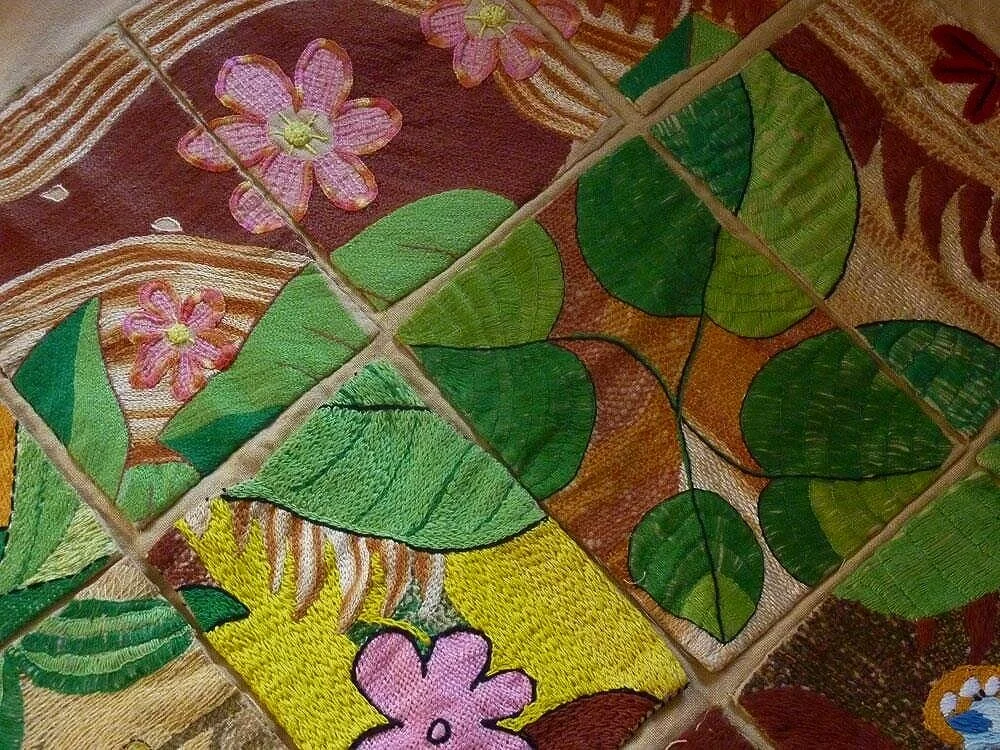
Eleanor Viegas: From the Cotswolds to Goa
‘I am because we are’.
A plurality of self forms the signature line for artworks by Eleanor Viegas. A language of interconnection and a holistic consciousness impregnates her works.. Read more